


How to Buy Bonds in Armenia: A Step-by-Step Guide
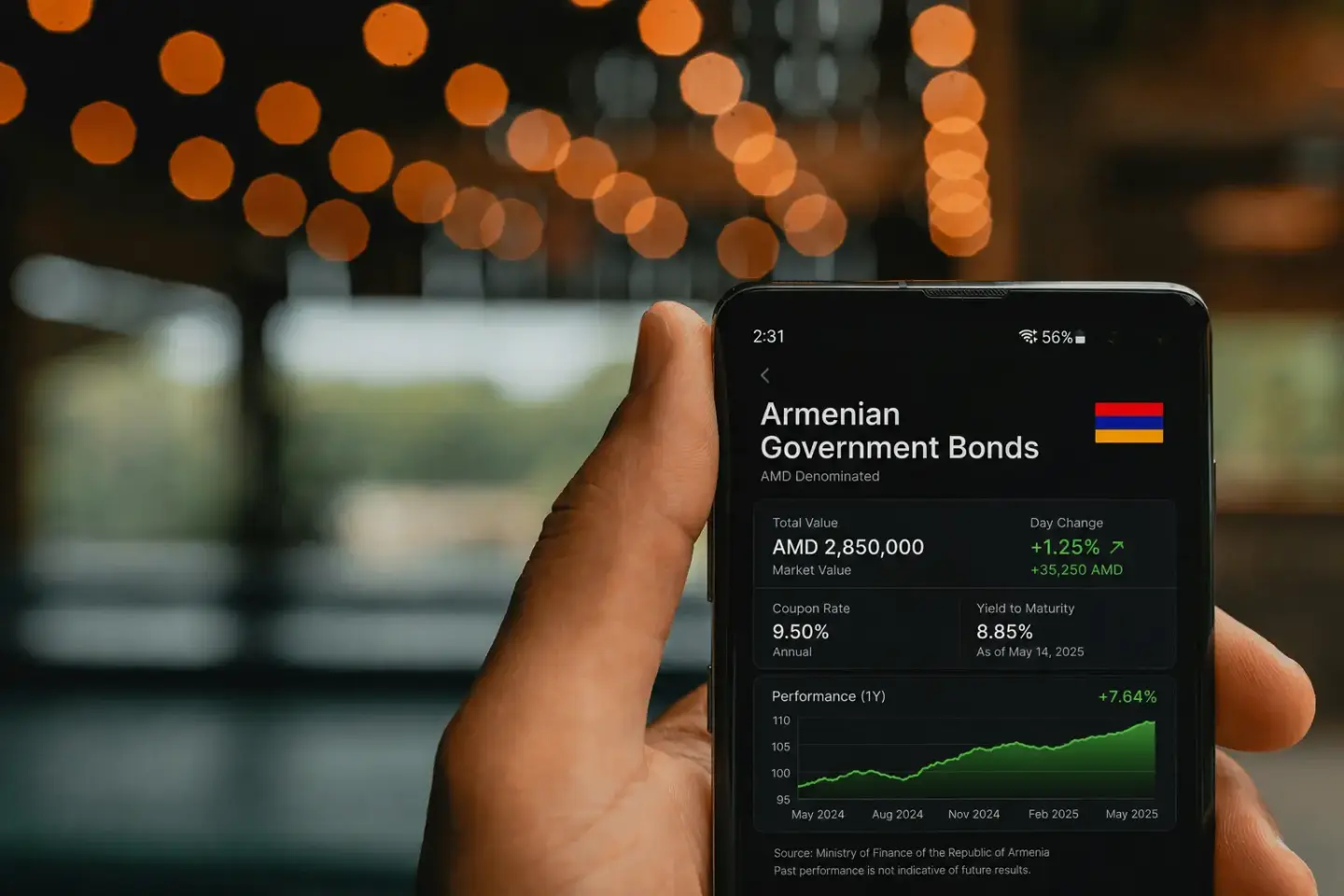
When people think about investing, they often first think of stocks, real estate, or bank deposits. However, bonds are one of the most important and widely used financial instruments in the world. They are used by governments, banks, and companies to raise money, while investors use them to earn regular income and preserve capital.
A bond is essentially a loan. When an investor buys a bond, they effectively lend money to the bond issuer. In return, the issuer undertakes to pay interest, usually at fixed intervals. These interest payments on a bond are called coupons. At the end of the bond’s term, the issuer must also return the original amount to the investor, that is, the nominal value of the bond. This is the key difference between bonds and stocks: when buying a stock, the investor becomes a co-owner of the company, while when buying a bond, the investor becomes its creditor.
In Armenia, the bond market has become increasingly accessible to individual investors. Today, investors can buy certain bonds through banks, investment companies, and brokerage services. Understanding how bonds work, where they are traded, and what risks to consider is essential before making an investment decision.
This guide explains the basics of bonds and provides a practical step-by-step overview of how to buy bonds in Armenia.
How to Make Money from Bonds
Investors can earn money from bonds in several ways. The most common source is the coupon payment, which is the interest paid by the bond issuer. For example, if an investor buys a bond with a nominal value of AMD 1,000,000 and an annual coupon rate of 10%, the investor receives AMD 100,000 per year before taxes and fees.
Investors may also earn from the difference between the purchase price and the repayment amount. If a bond is bought below its nominal value and repaid at full value at maturity, the difference becomes part of the investor’s return.
If the bond is traded in the secondary market, the investor may also sell it before maturity. In this case, the final result depends on the market price at the time of sale. For foreign-currency bonds, exchange rate movements can also affect the investor’s return in Armenian dram terms.
Therefore, bond income is not limited to the coupon rate alone. The actual return depends on coupon payments, purchase price, selling price, maturity value, currency changes, taxes, and transaction fees.
Bonds vs Bank Deposits in Armenia: Which Investment Option Is Better?
For many people in Armenia, bank deposits are the most familiar way to save money and earn interest. Deposits are simple, predictable, and easy to open through a bank branch or mobile application.
Bonds work differently. When an investor buys a bond, they lend money to an issuer, which can be the government, a bank, or a private company. In return, the issuer pays coupon income and repays the principal at maturity.
The main advantage of deposits is simplicity and legal protection within defined limits. The main advantage of bonds is the possibility of higher and regular coupon payments. However, bonds also require more analysis, because their price, liquidity, issuer risk, maturity, currency, and tax treatment may differ.
| Deposit | Bond | |
| Basic idea | You place money in a bank and earn interest | You lend money to an issuer and receive coupon payments |
| Issuer | Bank | Government, bank, or company |
| Income | Lower | Higher |
| Guarantee/protection | Covered by Deposit Guarantee Fund | Partially covered by Deposit Guarantee Fund |
| Early withdrawal/sale | Early withdrawal may reduce interest | Can be sold before maturity if there is a secondary market |
| Tax | 10% | Usually no tax |
Before choosing between bonds and deposits, investors should compare several parameters. The highest rate does not always mean that the instrument is actually more profitable.
1. Yield. When comparing a deposit and a bond, investors should compare the effective annual yield of the deposit with the bond’s yield to maturity. The effective yield of a deposit shows the actual annual return, taking into account capitalization, taxes, and possible fees. The yield to maturity of a bond shows the actual annual return, taking into account the purchase price, coupon payments, and the amount the investor will receive at maturity. The bond’s coupon rate should not be directly compared with the deposit rate, because the coupon does not take into account the purchase price of the bond.
2. Reliability. When comparing a deposit and a bond, investors should compare guarantee protection and issuer risk. Bank deposits of individuals in Armenia are guaranteed by the Deposit Guarantee Fund. If the deposit is opened only in AMD, the guaranteed amount is up to AMD 16 million. If the deposit is opened only in foreign currency, the guaranteed amount is up to AMD 7 million.
The guarantee applies not only to classic bank deposits, but also to funds attracted by a bank through registered securities issued by that bank, as well as to accrued interest on such funds. Therefore, for bank bonds, investors should check whether the issue terms state that the attracted funds are considered guaranteed bank deposits.
At the same time, government bonds and bonds issued by non-bank companies are not covered by the bank deposit guarantee system. For these bonds, the investor assesses the reliability of the issuer itself: the government or the company that issued the bond.
3. Term. A deposit is usually opened for a predetermined term, for example, 6 months, 1 year, or 2 years. A bond also has a maturity date. If the investor plans to hold the bond until the end of the term, they receive coupon payments and the nominal value at maturity. If the investor wants to exit earlier, the result will depend on the market price of the bond.
4. Early exit option. When comparing a deposit and a bond, investors should compare the investment term and early exit conditions. For a deposit, check the term of the agreement and the conditions for early withdrawal. For a bond, check the maturity date and the possibility of selling it earlier. If the bond is held to maturity, the investor receives coupon payments and the nominal value. If the bond is sold earlier, the result depends on the market price, which may be higher or lower than the purchase price.
5. Fees and expenses. When comparing a deposit and a bond, investors should compare the actual return after all fees and expenses. For deposits, fees are usually minimal or absent, but the bank’s conditions should still be checked. For bonds, check the fees for buying and selling, securities account maintenance, custody, fund transfers, and currency conversion. These expenses reduce the investor’s final return.
6. Taxes. When comparing a deposit and a bond, investors should compare after-tax returns. In Armenia, interest on bank deposits of individuals is taxed at a rate of 10%, while the deposit amount returned at the end of the term is not taxed.
For Armenian government bonds, coupon income, discount at maturity, and profit from sale are not subject to personal income tax. The nominal value received at maturity is also not taxed, because it is the return of the principal amount. For bonds issued by non-bank companies and listed on the Armenian stock exchange, such income is also exempt from tax. For bank bonds, the tax benefit applies only if the period from placement to maturity is at least two years. If the term is less than two years, coupon income and discount are taxed at a rate of 10%.
7. Minimum purchase amount. A deposit can often be opened with a relatively small amount. Bonds may have a minimum purchase amount, which depends on the nominal value of one bond and the terms of the specific issue.
8. Payment schedule. For a deposit, interest may be paid monthly, at the end of the term, or capitalized. For a bond, coupon payments are usually made according to a predetermined schedule, for example, monthly, quarterly, semi-annually, or annually. This is important for investors who need regular cash flow.
Types of bonds in Armenia
In Armenia, bonds can first be divided into two main groups: government bonds and corporate bonds. Government bonds include Treasury securities, savings coupon bonds, and sovereign Eurobonds issued by the Republic of Armenia. Corporate bonds include bonds issued by banks, credit organizations, and private companies.
Government Bonds
Government bonds are issued by the Republic of Armenia, usually through the Ministry of Finance. When investors buy these bonds, they are lending money to the government. In return, the government pays interest and repays the principal at maturity.
Government bonds are generally considered among the lower-risk instruments in the local market because they are backed by the state. They are often used by conservative investors who want predictable income and relatively higher reliability compared with corporate issuers.
In Armenia, government securities include short-term treasury bills, medium-term bonds, long-term coupon bonds, and savings coupon bonds. Depending on the type, they may pay income through regular coupon payments or through the difference between the purchase price and the nominal value at maturity.
Below, we have collected several issues of government savings coupon bonds placed in June 2026. They differ by time to maturity, annual coupon rate, and issue volume.
| ISIN | Issue Date | Maturity Date | Time to Maturity | Annual Coupon Rate | Issue Volume |
| AMGS0223C268 | 23.06.2026 | 23.12.2026 | about 6 months | 8.00% | 474,551,000 AMD |
| AMGS0423G271 | 23.06.2026 | 23.06.2027 | about 1 years | 8.50% | 462,756,000 AMD |
| AMGS0823G285 | 23.06.2026 | 23.06.2028 | about 2 years | 8.70% | 499,997,000 AMD |
| AMGS1223G297 | 23.06.2026 | 23.06.2029 | about 3 years | 9.00% | 491,244,000 AMD |
Corporate Bonds
Corporate bonds are issued by private companies or financial institutions. In Armenia, many corporate bonds are issued by banks, credit organizations, telecom companies, utility companies, and other businesses.
When an investor buys a corporate bond, they lend money to the company. The company then uses the funds for business development, refinancing, lending activity, or other financial needs. Corporate bonds usually offer higher yields than government bonds, but they also carry higher risk because repayment depends on the financial strength of the issuer.
Bank Bonds
Bank bonds are technically a type of corporate bond, but in Armenia they are common enough to be mentioned separately. These bonds are issued by commercial banks and are often offered directly through bank branches or digital channels.
Bank bonds may be attractive to retail investors because the issuer is familiar and the purchase process can be relatively simple. They may be issued in Armenian drams, US dollars, euros, or other currencies. However, investors should still remember that a bank bond is not the same as a regular bank deposit. It has its own terms, risks, maturity, and liquidity conditions. It is important to know that in Armenia, funds paid for the purchase of registered securities issued by a bank are insured: up to AMD 16 million for deposits in Armenian drams and up to AMD 7 million for deposits in foreign currency.
How to Buy Bonds in Armenia
There are several ways to buy bonds in Armenia. The right method depends on the type of bond the investor wants to buy.
The first option is to buy government bonds through Treasury Direct. This platform allows individuals to purchase Armenian government treasury securities directly online or through Treasury Direct service centers.
The second option is to buy bonds through a bank. Some banks offer their own bonds to clients, while others may also help investors access government bonds or open the necessary securities account.
The third option is to buy bonds through a broker or licensed investment company. This is usually needed when an investor wants to buy corporate bonds, listed bank bonds, or bonds traded in the secondary market.
It is important to understand that AMX is the marketplace where many bonds are listed and traded, but ordinary investors usually access this market through banks, brokers, or investment companies. In other words, the broker or bank works with the investor, while AMX provides the organized trading infrastructure.
How to Buy Government Bonds in Armenia Through Treasury Direct: Step-by-Step Guide
Investors who want to buy Armenian government treasury bonds online can use the Treasury Direct / Treasury Custodian online platform. The process includes opening a bank account, registering in the system, completing identification, activating the investor account, choosing a bond, calculating the purchase amount, and making the payment online.
Step 1: Open a bank account and get a payment card
Before using the Treasury Direct platform, the investor needs an Armenian dram bank account with one of the cooperating commercial banks, such as Ardshinbank, AMIO Bank, or Ameriabank. A virtual or payment card is also required, as it is used to make the bond purchase online.
Step 2: Register and complete identification on Treasury Direct
The investor enters the Treasury Direct website, clicks “Register,” and creates an account. After the first login, the account status is shown as “Passive.” To activate it, the investor must complete the registration form, provide personal and bank information, and pass identification.
Armenian citizens can complete identification through an ID card or online registration. Foreign investors can register through the online registration option. During the process, the investor may be asked to choose a video call time for identification.
Step 3: Make the identification payment and wait for activation
During registration, the investor makes a one-time AMD 500 identification payment through the V-POS payment window. This amount is refunded immediately. After the application is reviewed and approved, the account status changes from “Passive” to “Active.” Only then can the investor buy bonds through the platform.
Step 4: Choose a bond and calculate the purchase amount
Once the account is active, the investor can view the list of available government treasury bonds. After selecting a bond, the investor clicks “Calculate / Buy,” enters the planned investment amount, and the system shows the purchase price, coupon payment schedule, and principal repayment details.
Step 5: Buy the bond and track transactions
To complete the purchase, the investor clicks “Buy” and makes the payment through the State Electronic Payment System. After payment, confirmation is sent to the investor’s email.
No brokerage commission is charged. However, when purchasing online, a payment system transfer fee applies at 0.15% of the transaction amount, but not more than AMD 400.
After buying bonds, the investor can use the personal account to track transactions, download account statements, certificates, and other reports.
How to Buy Bonds in Armenia Through a Broker: Step-by-Step Guide
Investors who want to buy corporate bonds, bank bonds, or bonds traded in the secondary market usually do so through a bank, broker, or licensed investment company. In this case, the investor does not buy directly from AMX. The broker or bank provides access to the market and executes the investor’s order.
Step 1: Choose a licensed broker, investment company, or bank
The investor should first choose a licensed investment service provider. In Armenia, bonds can be purchased through banks that provide investment or brokerage services, as well as through licensed investment companies. Below is a list of licensed investment companies in Armenia.
Before opening an account, it is useful to compare fees, account opening requirements, availability of online access, available bonds, quality of customer support, minimum transaction amount, and access to securities listed on AMX.
| The list of licensed investment companies in Armenia |
| WILCO LԼC |
| Incore CJSC |
| Tonton LTD |
| Future Capital Market LTD |
| ROQ Capital OJSC |
| Equiti A M CJSC |
| Cube Invest CJSC |
| Dimension CJSC |
| Landmark Capital CJSC |
| G&L Invest LTD |
| GM Invest LTD |
| AB Invest LTD |
| Freedom Finance Armenia LTD |
| APRICOT CAPITAL CJSC |
| ARFI CJSC |
| Meta-X Markets CJSC |
| Invia Investments CJSC |
| FIDO INVEST CJSC |
| NEW VENTURE BROKERAGE CJSC |
| Sirius Capital CJSC |
| EQWEFY AM CJSC |
| AKTINA CAPITAL LLC |
| Premium Invest LLC |
| ADEX CJSC |
| C Capital and lnvestments, LLC |
Step 2: Open an investment account and complete verification
After choosing a provider, the investor opens a brokerage or investment account. This usually requires an application, identification documents, and client verification. The provider may also ask about tax residency, source of funds, investment experience, risk tolerance, and investment goals.
The purchased bonds are recorded in the investor’s securities or custody account.
Step 3: Fund the account
Once the account is approved, the investor transfers money to the brokerage or investment account. Before transferring funds, the investor should check accepted currencies, transfer fees, account maintenance fees, and brokerage commissions.
Step 4: Choose a bond
The investor can then choose a corporate bond, bank bond, or government bond available in the secondary market. Before buying, it is important to review the issuer, currency, coupon rate, yield to maturity, maturity date, payment schedule, liquidity, tax treatment, and main risks.
A bond should not be compared only by coupon rate. A higher coupon may also mean higher issuer risk, lower liquidity, longer maturity, or currency risk.
Step 5: Place a buy order
After selecting the bond, the investor places a buy order through the broker or bank. The order may include the bond name or ISIN, quantity, price or yield, currency, and validity period.
If the bond is available at the requested price, the order is executed. If not, the order may remain pending, be partially executed, or not be executed.
Step 6: Confirm the transaction and receive payments
After the order is executed and settled, the bond is recorded in the investor’s account. The investor receives a confirmation showing the bond, quantity, price, transaction value, commission, and settlement date.
After that, the investor receives coupon payments according to the bond’s payment schedule.
Step 7: Hold until maturity or sell before maturity
The investor can hold the bond until maturity and receive the principal repayment from the issuer. Alternatively, if the bond is traded in the secondary market, the investor may sell it before maturity through the broker or bank.
Selling before maturity depends on market liquidity and price. The investor may earn a capital gain, but may also sell at a lower price.
In short, buying bonds through a broker gives investors access to a wider range of instruments, including corporate bonds, bank bonds, and secondary-market trades. However, it requires more analysis than buying a simple bank deposit or a government savings bond through Treasury Direct.
Conclusion
Bonds can be a useful investment option for people in Armenia who want regular income, portfolio diversification, and an alternative to traditional bank deposits. Investors can buy government bonds through Treasury Direct or access a wider range of bank and corporate bonds through banks, brokers, and licensed investment companies. However, before investing, it is important to compare the issuer, currency, coupon rate, maturity, taxes, fees, liquidity, and guarantee coverage. Bonds may offer attractive returns, but they are not risk-free, so every investment decision should be based on careful analysis and a clear understanding of the risks.
Main recommendation. For people in Armenia who keep most of their savings only in bank deposits, bonds can be an interesting additional opportunity. They may offer regular coupon income, portfolio diversification, and access to instruments issued by the government, banks, and companies. However, bonds should not be chosen only because the coupon rate looks higher than a deposit rate. Before investing, it is important to compare the issuer, currency, maturity, tax treatment, fees, liquidity, and guarantee coverage. A reasonable approach for beginners is to start with simpler and more transparent instruments, such as government bonds or familiar bank bonds, and only then consider corporate bonds or secondary-market trades after understanding the risks.
Author
Rafayel PetrosyanSource
AFMTopic
Finance Made Simple, Investments, Inecobank, Evocabank, Ardshinbank, ID Bank, AMIO Bank, Ameriabank, Central Bank of Armenia